

WordPress Website Development for Businesses
Professional WordPress website development for businesses that need a reliable, responsive and easy-to-manage online presence.
I build and customize WordPress websites around real business requirements, combining clear structure, responsive design, reliable functionality and the integrations needed to support day-to-day operations.
From professional service websites and lead-generation pages to WooCommerce, forms, bookings, CRM connections, APIs and automation, the objective is to create a website that works as part of the business rather than simply existing online.
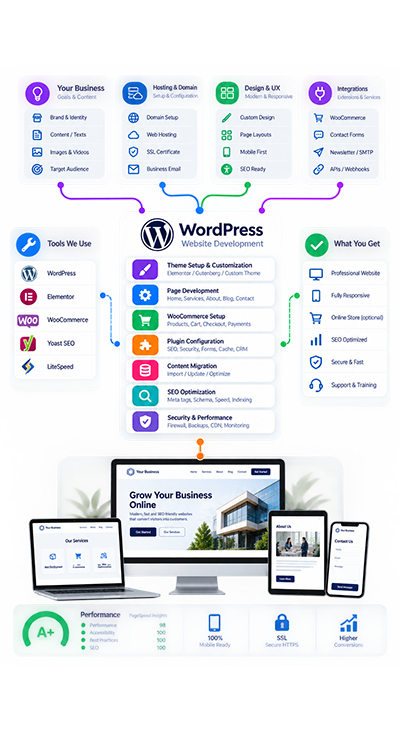
WordPress Website Development Overview
A business website needs more than an attractive homepage.
It needs a solid structure, responsive layouts, reliable forms, clear navigation, appropriate integrations and an administration environment that can continue evolving as the business grows.
I develop WordPress websites for companies, entrepreneurs and professional service providers that need a practical platform for presenting their services, capturing opportunities and connecting the website with other business tools.
Depending on the project, the website can include custom layouts, forms, bookings, WooCommerce, payment integrations, APIs, CRM connections, automation and multilingual functionality.
What Exactly Do I Build?
Depending on your requirements, I can develop or customize:
- Business WordPress websites
- Professional service websites
- Corporate websites
- Custom page layouts
- Responsive website structures
- Contact and lead-generation forms
- Booking and appointment functionality
- WooCommerce functionality
- Payment integrations
- CRM connections
- Email and automation integrations
- API and third-party integrations
- Multilingual websites
- Technical SEO foundations
- Performance-oriented configurations
- Existing WordPress website improvements
The exact scope depends on what the website needs to accomplish.
Why Use WordPress for a Business Website?
WordPress provides a flexible foundation for businesses that need more control than a closed website builder but do not necessarily require a completely custom application.
It can support:
- Business websites
- Service pages
- Landing pages
- Blogs and content
- Ecommerce
- Lead capture
- Booking systems
- Membership functionality
- API integrations
- Automation
- Multilingual content
Its flexibility also allows the website to grow progressively instead of requiring a complete rebuild whenever a new requirement appears.
Three Types of WordPress Website Projects
New Business Websites
A complete WordPress website built from the ground up around the business, audience and required functionality.
This may include:
- Page structure
- Responsive layouts
- Service pages
- Contact forms
- Lead capture
- Integrations
- Performance configuration
- Basic technical SEO foundations
Existing WordPress Website Improvements
Not every project requires rebuilding the entire website.
An existing WordPress site can be reviewed and improved through:
- Layout adjustments
- New sections or pages
- Plugin configuration
- Form improvements
- Performance optimization
- Integration work
- Technical fixes
- Functional improvements
WordPress Websites With Advanced Integrations
For businesses that need more than standard website functionality, WordPress can connect with external systems.
This may involve:
- CRM platforms
- APIs
- Webhooks
- Email systems
- Databases
- Automation platforms
- Payment providers
- Internal business tools
Benefits of a Professionally Developed WordPress Website
Built Around Your Business
Responsive Across Devices
Ready for Integrations
Able to Grow Over Time
Ready for Real Business Use
Lead Generation
Forms, calls to action and contact points can be configured to support inquiries and lead capture.
Business Integrations
The website can communicate with CRM systems, email platforms, APIs and automation tools when the project requires it.
Ecommerce & Payments
WooCommerce and supported payment functionality can be incorporated when the business needs to sell products or services online.
Business Website Structure
A WordPress website should make it easy for visitors to understand:
- What the business does
- Who the service is for
- What solutions are available
- Why the company is relevant
- How to request information
- What the next step should be
The exact structure depends on the business, but a typical website may include:
- Home
- About
- Services
- Individual service pages
- Portfolio or projects
- FAQs
- Blog or resources
- Contact
- Legal pages
The objective is to create a clear information architecture rather than simply assembling pages.
Custom Layouts & Responsive Design
I build layouts adapted to the information that needs to be communicated.
The website is configured to work across different screen sizes, with attention to:
- Content hierarchy
- Navigation
- Spacing
- Readability
- Mobile behavior
- Calls to action
- Forms
- Images and media
Responsive design is treated as part of the implementation, not as an optional adjustment added at the end.
Forms, Booking & Lead Capture
Forms can be integrated into the website according to the business process.
This may include:
- Contact forms
- Quote requests
- Lead forms
- Booking requests
- Appointment forms
- Custom information fields
Form submissions can also become the starting point for additional automation or integration.
For example:
Website form → validate information → CRM → notification → follow-up workflow.
WooCommerce & Payment Integration
When a business needs ecommerce functionality, WooCommerce can be integrated into the WordPress website.
Depending on the project, this can include:
- Products
- Product categories
- Cart
- Checkout
- Payment methods
- Customer information
- Order-related functionality
- Integrations with external systems
The exact ecommerce scope should be defined separately from a standard business website.
API & Third-Party Integrations
A WordPress website can communicate with other platforms through APIs or available integrations.
This can allow the site to participate in processes such as:
- CRM synchronization
- Lead processing
- Customer data exchange
- External service connections
- Booking systems
- Payment processes
- Internal business workflows
The objective is to avoid keeping the website isolated when the business already relies on other systems.
CRM, Email & Automation Connections
WordPress can become part of an automated business process.
Depending on the requirement, website events can trigger actions involving:
- CRM platforms
- Email systems
- n8n
- APIs
- Google Sheets
- Databases
- Notifications
- Lead follow-up
This allows the website to support operational workflows rather than simply collect information.
Performance & Technical Foundations
A business website should be built with performance and technical stability in mind.
Depending on the project, implementation may consider:
- Image optimization
- Plugin selection
- Caching
- Page structure
- Theme configuration
- Script usage
- Responsive assets
- Database considerations
- Hosting environment
Actual performance also depends on hosting, third-party scripts, plugins and the amount of content used on the website.
SEO-Ready Technical Structure
WordPress provides a strong foundation for SEO when configured correctly.
The website can be structured with attention to:
- Heading hierarchy
- Page titles
- Meta descriptions
- Internal linking
- Clean URLs
- Sitemap configuration
- Indexing settings
- Structured data when appropriate
- Mobile usability
- Performance
This provides a technical foundation for SEO, but it does not imply guaranteed rankings.
Multilingual WordPress Websites
When required, the website can be prepared to manage content in more than one language.
The exact implementation depends on:
- Number of languages
- Website structure
- Translation workflow
- Plugin selection
- SEO requirements
- URL architecture
A multilingual setup should be planned from the beginning whenever possible to avoid unnecessary structural changes later.
Designed for Production
A production website should remain stable after launch.
I focus on clear implementation, controlled plugin usage and functionality that can be maintained.
Depending on the project, this may include:
- Clean page structure
- Appropriate plugin configuration
- Compatibility checks
- Responsive testing
- Form testing
- Integration testing
- Error review
- Basic security considerations
- Backup and maintenance planning
Stable and Controlled Technical Development
I avoid adding unnecessary plugins or functionality simply because they are available.
The goal is to build a WordPress website that is:
- Clear
- Functional
- Maintainable
- Responsive
- Expandable
- Connected to the real business requirement
When custom code or integration work is required, it should solve a specific problem rather than add unnecessary complexity.

Why Work With Me?
Our Process
Project Analysis
First, I review the business and the website requirements:
- Purpose of the website
- Target audience
- Required pages
- Current content
- Required functionality
- Integrations
- Existing systems
- Future expansion needs
Website Planning
Page structure, content requirements, navigation, functionality, forms, integrations, responsive behavior, technical requirements and expected result.
WordPress Development
I build and configure the website based on the agreed structure.
Depending on the project, this may include:
- WordPress setup
- Page layouts
- Responsive implementation
- Forms
- WooCommerce
- Plugins
- Custom functionality
- APIs
- CRM connections
- Automation integrations
Testing & Validation
Desktop, tablet, mobile, navigation, forms, links, integrations, responsive behavior, main functionality and technical review.
Launch & Review
The completed website is reviewed as a complete user journey before or during launch so the main pages and functionality work as intended.
Existing WordPress Website Review
You do not necessarily need a new website.
If you already have a WordPress website, I can review the current implementation to identify areas such as:
- Layout problems
- Broken functionality
- Plugin issues
- Responsive problems
- Form errors
- Slow pages
- Technical SEO issues
- Missing integrations
- Difficult-to-maintain configurations
From there, we can determine whether improving the existing website is more practical than rebuilding it.
Ongoing WordPress Support
Websites evolve after launch.
WordPress, plugins, integrations and business requirements can change over time.
Ongoing support can help with:
- Updates
- Technical fixes
- New pages
- New functionality
- Performance reviews
- Plugin adjustments
- Integration changes
- Website improvements
Maintenance scope should be defined separately from the initial development project.
What Can Be Monitored?
Depending on the website and maintenance arrangement, useful areas to monitor can include:
- Website availability
- Form functionality
- Plugin updates
- WordPress updates
- Error logs
- Performance
- Broken links
- Integration failures
- Security-related events
- Backup status
Monitoring requirements depend on the importance and complexity of the website.
What You Can Achieve
A professionally developed WordPress website can provide:
- A clear professional online presence
- Responsive access across devices
- Better presentation of services
- Structured lead capture
- Easier content management
- Integration with business systems
- A foundation for technical SEO
- Room for future functionality
- Better alignment between the website and business processes
These are functional and operational benefits rather than guarantees of traffic, rankings or sales.
What You Receive
Depending on the agreed scope, a WordPress website development project can include:
- WordPress website implementation
- Responsive page layouts
- Website navigation
- Contact and lead forms
- Plugin setup and configuration
- WooCommerce when included
- Payment integration when included
- API and third-party integrations
- CRM or email connections
- Performance-oriented configuration
- Technical SEO foundations
- Testing before delivery
Hosting, domain registration, premium plugin or theme licenses, paid APIs, third-party subscriptions, photography, logo design and written content are normally separate unless explicitly included in the agreed project scope.
Common Problems This Service Can Solve
The Business Does Not Have a Professional Website
A complete WordPress site can be developed around the company’s services, audience and contact process.
The Existing Website Looks Outdated
The current WordPress structure and layouts can be reviewed and improved without automatically rebuilding everything.
The Website Does Not Generate Useful Leads
Forms, calls to action and lead-capture processes can be improved and connected with the appropriate business systems.
WordPress Is Isolated From the Rest of the Business
APIs, CRM systems, automation and external tools can be integrated when technically appropriate.
The Website Is Difficult to Maintain
The implementation can be simplified and organized around a clearer technical structure.
Start Your WordPress Website Project
If your business needs a new WordPress website or an existing site requires a major improvement, the first step is understanding what the website actually needs to accomplish.
Tell me what your business does, what pages or functionality you need, what you already have and which systems the website should connect with.
From there, I can determine the most practical WordPress implementation for the project.
Professional WordPress Development for Business Websites
WordPress can support much more than a basic company homepage.
A properly developed site can combine professional content, lead generation, WooCommerce, forms, bookings, CRM connections, APIs and automation within one flexible platform.
I develop WordPress websites around real business requirements, with attention to responsive implementation, technical stability, maintainability and the integrations needed to support future growth.
FAQ: WordPress Website Development for Businesses
Can you build a completely new WordPress website?
Yes. I can develop a new WordPress website from the initial structure through responsive implementation, forms, functionality and the integrations included in the agreed scope.
Can you work on an existing WordPress website?
Yes. Existing websites can be reviewed, customized, corrected or expanded when rebuilding everything is not necessary.
What types of businesses can use WordPress?
WordPress can be suitable for professional services, companies, consultants, ecommerce businesses, educational organizations and many other businesses depending on their technical requirements.
Is the website mobile responsive?
Yes. Responsive behavior across desktop, tablet and mobile is part of the website implementation.
Can you build custom page layouts?
Yes. Layouts can be adapted to the content, branding and structural needs of the project rather than relying only on unmodified templates.
Can you add WooCommerce?
Yes. WooCommerce can be incorporated when the project requires ecommerce functionality.
Can you integrate payment methods?
Yes. Supported payment methods can be configured when ecommerce or payment functionality forms part of the agreed scope.
Can you add contact forms and lead-generation forms?
Yes. Contact, quote, lead-generation and other forms can be implemented according to the project's requirements.
Can WordPress connect with a CRM?
Yes. WordPress can connect with CRM platforms through supported integrations, APIs, webhooks or automation tools depending on the systems involved.
Can you connect WordPress with APIs?
Yes. Custom API or third-party integration can be included when the external service provides the required technical access.
Can the website include automation?
Yes. Website actions can connect with automation platforms such as n8n to support processes involving leads, CRM systems, email, databases and other business tools.
Can you build a multilingual WordPress website?
Yes. Multilingual functionality can be implemented when included in the project requirements.
Is SEO included?
The website can include SEO-ready technical foundations such as appropriate structure, headings, URLs, metadata configuration and indexing settings. Ongoing SEO strategy and ranking work should be treated separately.
Are hosting, domain and premium plugins included?
Not normally. Hosting, domain registration, premium themes, premium plugins and external subscriptions are separate unless explicitly included in the agreed scope.
Do you provide the text, logo, images and other website content?
Normally, the client provides written content, logo, images, product information and other brand materials unless additional content work is agreed separately.