

Scalable AI WhatsApp Bot Architecture with n8n – Case Study
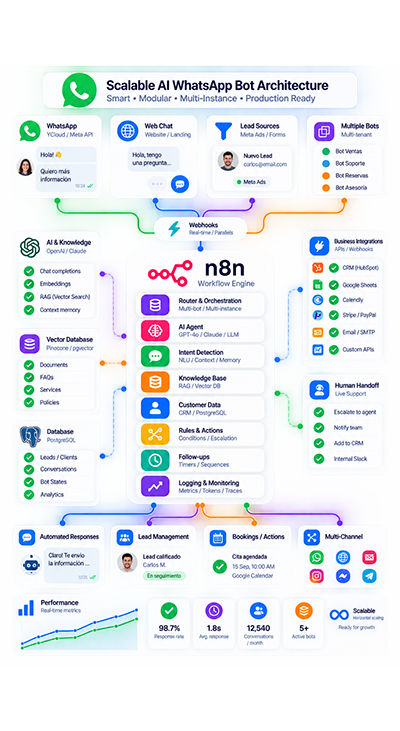
Modular AI WhatsApp bot architecture developed with n8n to separate responsibilities, reuse common components and adapt each implementation to the specific business rules of different clients.
This project was created after identifying a recurring limitation in conversational automation: a bot can start with only a few workflows, but as memory, message interpretation, actions, appointment management, human handoff, business rules and external integrations are added, keeping everything inside one large workflow becomes difficult to scale, maintain and debug.
The objective was therefore not to build one more WhatsApp bot, but to create a stronger reusable architecture that could support multiple implementations without rebuilding the core logic from scratch each time.
The Challenge
A simple WhatsApp bot can work correctly with only a few flows.
The problem appears as the solution begins to incorporate additional responsibilities such as:
- Message interpretation
- Intent detection
- Conversational memory
- Actions
- Appointment management
- Availability
- Human handoff
- Business-specific rules
- Persistent states
- External APIs
- Webhooks
- Multiple integrations
When all of these responsibilities remain concentrated inside a single workflow, the automation becomes increasingly difficult to understand, modify and debug.
A change in one part of the bot can begin affecting unrelated behavior elsewhere.
The challenge was to create an architecture that could grow without turning every new capability into additional complexity inside the same workflow.
The Objective
The goal was to establish a reusable foundation for AI-powered WhatsApp bots.
Instead of rebuilding the complete logic for every implementation, the architecture needed to separate:
Reusable system logic from business-specific configuration and behavior.
This would make it possible to reuse the technical foundation while adapting elements such as:
- Services
- Business hours
- Responses
- Commercial rules
- Available actions
- Conversational behavior
The architecture therefore needed to support both technical reuse and business-specific customization.
The Solution
I designed and implemented a distributed modular architecture using n8n, where specialized workflows handle different responsibilities.
The solution separates functions such as:
- General orchestration of each conversation
- Message understanding and intent detection
- Action resolution according to context and state
- Conversational memory and continuity
- WhatsApp Business integration
- Appointment and availability management
- Human handoff
- Persistent state and data management
- Business-specific configuration
- APIs, webhooks and external service integrations
Each module has a defined responsibility rather than allowing the entire conversational system to grow inside one monolithic workflow.
Modular Conversational Architecture
The main architectural principle is separation of responsibilities.
Instead of one workflow being responsible for interpreting the message, deciding the intent, remembering the conversation, executing actions, managing appointments and sending the response, those responsibilities can be distributed across specialized components.
Conceptually:
WhatsApp message → conversation orchestration → message understanding → context/state evaluation → action resolution → specialized module → response or external action.
This allows each part of the system to evolve independently while remaining coordinated through the overall architecture.
Conversation Orchestration
The orchestration layer coordinates the general lifecycle of each interaction.
Its role is not necessarily to contain every piece of business logic itself, but to determine which specialized parts of the architecture need to participate in the current turn.
At a high level, orchestration can coordinate:
- Incoming conversation event
- Current context
- Message understanding
- Required action
- Specialized workflow
- Updated state
- Final response or next step
This creates a central coordination point without concentrating every responsibility in a single workflow.
Message Understanding & Intent Detection
Understanding what the user is asking is separated from the rest of the process.
The architecture includes a dedicated responsibility for:
- Understanding the incoming message
- Interpreting its meaning
- Detecting the relevant intent
This information can then be used by the rest of the system to determine which action should occur.
Separating conversational understanding from execution also makes the architecture easier to modify when interpretation logic changes.
Context-Aware Action Resolution
Understanding a message is only one part of the process.
The system must also determine what should happen according to:
- The detected intent
- Existing conversation context
- Current state
- Available actions
- Business rules
The action-resolution layer determines the appropriate next step based on that information.
This creates an important separation:
Understanding what the customer means is different from deciding what the system is allowed or expected to do next.
That separation helps keep conversational AI under the control of explicit workflow logic.
Conversational Memory & Continuity
A conversational system needs continuity between interactions.
The architecture includes memory and state responsibilities so the bot can preserve relevant information rather than treating every incoming message as an unrelated event.
This supports conversations that evolve across multiple turns.
Conceptually:
Previous interaction → stored context/state → new message → interpretation with existing context → next action → updated state.
The objective is to maintain a coherent conversation while keeping memory management separate from unrelated workflow responsibilities.
WhatsApp Business Integration
WhatsApp Business provides the communication layer between the user and the automation.
The architecture keeps WhatsApp integration as one specialized component rather than embedding all conversational and business logic directly into messaging operations.
This separation allows WhatsApp communication to remain connected with:
- Conversation orchestration
- AI interpretation
- State management
- Business rules
- Actions
- Human handoff
- External systems
The messaging channel therefore becomes part of a broader architecture rather than the place where the complete bot logic lives.
Appointment & Availability Management
Appointment-related functionality was also separated into a specialized responsibility.
Instead of mixing scheduling logic with general conversation processing, the architecture can route relevant interactions toward appointment and availability management.
This separation makes it easier to evolve scheduling functionality independently from the rest of the conversational system.
For example:
Appointment-related intent → evaluate context → route to appointment module → process availability or required action → return result to conversation.
The exact business behavior remains configurable according to the implementation.
Human Handoff
The architecture includes human handoff as a defined part of the system.
Automation should be able to recognize when a conversation needs to leave the automated route and be transferred for human attention.
This creates a hybrid model:
Automated conversation and actions → handoff condition detected → conversation routed toward human attention.
Treating handoff as an architectural responsibility rather than an improvised exception helps maintain control over how automated and human conversations interact.
Persistent States & Data
Persistent information is important when conversations and business processes continue across multiple interactions.
The architecture includes state and data persistence so the system can maintain relevant information outside an individual n8n execution.
PostgreSQL forms part of the technology stack used for this persistence.
This can support continuity between:
- Conversation turns
- Workflow executions
- Business states
- Actions
- Subsequent interactions
The key architectural idea is that state should remain available when the next event occurs.
Business-Specific Configuration
One of the most important design decisions was keeping shared infrastructure separate from the configuration of each business.
The common architecture can be reused, while individual implementations can define elements such as:
- Services
- Business hours
- Responses
- Commercial rules
- Available actions
- Conversational behavior
This avoids hardcoding every client’s logic into the reusable core.
Conceptually:
Reusable architecture + business configuration = customized bot implementation.
That separation makes the system more practical when multiple bots share the same technical foundation but serve different businesses.
APIs, Webhooks & External Services
The architecture was designed to connect with APIs, webhooks and external services.
External integrations can be treated as specialized components within the broader workflow structure instead of being mixed directly into every conversational flow.
This allows the system to interact with other platforms while preserving a modular organization.
A simplified architecture may look like:
WhatsApp Business → n8n orchestration → AI/context modules → business logic → API/webhook/external service → updated state → response.
The exact integrations depend on the requirements of each implementation.
Why a Modular Architecture?
A monolithic bot can appear simpler at the beginning.
But as responsibilities increase, one large workflow can become difficult to:
- Understand
- Test
- Debug
- Modify
- Reuse
- Expand
The modular approach allows responsibilities to remain more clearly separated.
A change to appointment logic, for example, does not necessarily require redesigning the complete message-understanding system.
Similarly, changing the configuration of one business should not require rewriting the shared architecture.
Reusable Core, Custom Business Logic
The architecture separates two important layers.
Reusable Core
Contains the common technical responsibilities needed by multiple conversational implementations.
Examples include:
- Orchestration
- Intent processing
- Memory
- State handling
- WhatsApp integration
- Action routing
- Human handoff
- Integration patterns
Business Configuration
Defines the characteristics unique to each implementation.
Examples include:
- Services
- Schedules
- Responses
- Business rules
- Available actions
- Conversational behavior
This makes it possible to reuse infrastructure without forcing different businesses to behave identically.
Easier Maintenance & Debugging
Separating responsibilities also improves troubleshooting.
When something behaves incorrectly, it becomes easier to identify whether the issue belongs to:
- Message understanding
- Action resolution
- State management
- WhatsApp communication
- Appointment logic
- External integration
- Business configuration
This is much more manageable than debugging a single workflow responsible for every aspect of the bot.
The source project specifically identified scalability and debugging difficulty as problems the modular architecture was designed to address.
Easier Evolution of New Bots
One of the main goals was to create a foundation that could support future bots.
Instead of starting from zero for every new implementation, the architecture allows reusable modules to provide the base while new business requirements are configured or extended.
This can reduce unnecessary duplication in areas where several implementations require the same technical capabilities.
The architecture can therefore evolve progressively as new requirements appear.
My Role in the Project
I was responsible for the technical design and implementation of the architecture, including:
- Architecture design
- Definition of responsibilities between workflows
- n8n implementation
- Artificial intelligence integration
- WhatsApp integration
- State management
- Memory management
- Testing
- Debugging
- Evolution of the different modules
The project required both conversational automation work and architectural decisions about how different responsibilities should communicate with each other.
Technical Architecture
The documented technology stack includes:
n8n
Provides the workflow orchestration environment and coordinates the specialized modules.
Artificial Intelligence
Supports conversational understanding and interpretation as part of the architecture.
WhatsApp Business
Provides the messaging channel used by the conversational system.
PostgreSQL
Supports persistent state and data required across interactions and workflow executions.
APIs & Webhooks
Connect the architecture with external systems and event-driven integrations.
Modular Workflow Architecture
Separates specialized responsibilities into reusable components.
Together, these technologies provide the foundation for a conversational automation system designed to evolve beyond a single bot implementation.
Designed for Scalable Conversational Automation
In this context, scalability is not simply about processing more messages.
It also means being able to:
- Add capabilities without redesigning the complete system
- Reuse technical modules
- Customize implementations for different businesses
- Maintain clear workflow responsibilities
- Extend integrations
- Debug individual components
- Evolve conversation behavior over time
That architectural scalability was the central objective of the project.
The Result
The project produced a modular foundation for AI-powered WhatsApp bots that separates reusable technical components from business-specific configuration.
The architecture supports specialized responsibilities for:
- Conversation orchestration
- Message understanding
- Intent detection
- Context-aware action resolution
- Conversational memory
- WhatsApp Business
- Appointment and availability management
- Human handoff
- Persistent state and data
- Business configuration
- APIs, webhooks and external services
The result is an architecture that can be modified, extended and reused without forcing every implementation to rebuild the complete conversational logic from scratch.
What This Project Demonstrates
This case study demonstrates practical experience with:
- n8n architecture
- AI-powered conversational automation
- WhatsApp Business integration
- Modular workflow design
- Intent detection
- Context-aware actions
- Conversational memory
- Persistent state management
- PostgreSQL
- Appointment workflows
- Human handoff
- APIs
- Webhooks
- Business-specific configuration
- Reusable automation components
More importantly, it demonstrates the architectural difference between building one chatbot and building a reusable foundation capable of supporting multiple conversational systems.
Related Services
AI Integrations with CRM, WhatsApp & APIs
Need a Scalable AI WhatsApp Bot Architecture?
If your current WhatsApp automation has grown into a large workflow that is becoming difficult to maintain, or if you need a reusable foundation for several bots or business implementations, a modular architecture may be worth evaluating.
I can review:
- Current workflow structure
- Conversation responsibilities
- Intent detection
- Existing memory and states
- Available business actions
- WhatsApp integration
- Appointment logic
- Human handoff
- APIs and webhooks
- Database requirements
- Business-specific configuration
- Opportunities to separate reusable modules
Tell me how your current WhatsApp bot is structured, which responsibilities are concentrated in the same workflow and what you need the system to support as it grows.
From there, I can evaluate whether a modular n8n architecture is appropriate.
FAQ: Scalable AI WhatsApp Bot Architecture with n8n
What is a modular AI WhatsApp bot architecture?
It is an architecture where different responsibilities such as orchestration, message understanding, memory, actions, appointments, handoff and integrations are separated into specialized components instead of being concentrated inside one large workflow.
Why use a modular architecture for WhatsApp bots?
As a bot gains more capabilities, a single workflow can become difficult to scale, maintain and debug. Separating responsibilities makes it easier to evolve individual parts of the system.
Why use n8n for this architecture?
n8n provides the workflow environment used to coordinate specialized modules, integrations, business logic and conversational processes.
Is artificial intelligence part of the architecture?
Yes. Artificial intelligence is part of the documented implementation and supports conversational understanding and message interpretation.
Can the architecture detect user intent?
Yes. Message understanding and intent detection are separate responsibilities within the modular design.
Can actions depend on conversation context?
Yes. The architecture includes action resolution according to context and current state.
Does the system maintain conversational memory?
Yes. Memory and conversational continuity are part of the architecture.
Can it manage appointments and availability?
Yes. Appointment and availability management are included as specialized responsibilities in the documented architecture.
Can conversations be transferred to a person?
Yes. Human handoff is one of the functions separated within the architecture.
Why is persistent state important?
Persistent state allows relevant information to remain available between different messages and workflow executions instead of treating each interaction as completely independent.
Why is PostgreSQL part of the architecture?
PostgreSQL forms part of the documented technology stack and supports persistent state and data required by the conversational system.
Can the architecture connect with APIs and webhooks?
Yes. Integration with APIs, webhooks and external services is one of the responsibilities supported by the architecture.
Can the same architecture be reused for different businesses?
That was one of the main objectives of the project. Shared logic remains separated from business-specific configuration so the technical foundation can be reused while services, schedules, responses, rules and behavior are adapted.
Does every business bot behave exactly the same?
No. The reusable infrastructure can remain common while business-specific configuration determines services, schedules, responses, commercial rules, available actions and conversational behavior.
What is the main advantage over one large n8n workflow?
The modular approach makes it easier to modify or improve individual components, reuse infrastructure, debug problems and evolve different bots without rebuilding the complete logic from zero.