

Sales Automation and Lead Follow-Up
Turn enquiries into opportunities and automate your sales follow-up without losing leads along the way
Many companies receive leads from forms, WhatsApp, social media, advertising campaigns, phone calls, or different platforms.
The problem comes afterward.
Information has to be registered manually, some contacts take too long to receive a response, follow-ups depend on someone remembering them, and many opportunities are lost simply because there was no clear process to continue the conversation.
That is where sales automation and lead follow-up come in.
I design and implement processes that allow you to capture, organize, classify, and automatically follow up with new prospects by connecting forms, WhatsApp, CRM, email, calendars, databases, APIs, and artificial intelligence.
From an initial response to qualification processes, reminders, sales follow-up, bookings, payments, and handoff to the sales team.
A more organized, faster, and more consistent sales process from the moment a lead arrives until human intervention is required.
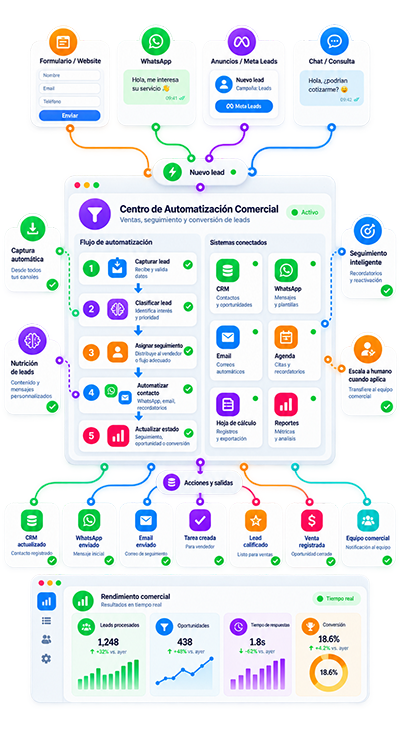
Service Overview
What exactly do I do?
I analyze how leads currently reach your company and what happens after someone shows interest.
Based on that process, I can implement automations such as:
- Automatic capture of new leads
- Contact registration in CRM
- Consolidation of leads from different channels
- Classification by source, interest, or need
- Automatic initial responses
- Opportunity qualification
- Scheduled sales follow-ups
- Automatic reminders
- Lead status updates
- Opportunity assignment to sales representatives
- WhatsApp integration
- Email automation
- Calendar and booking integration
- Payment link delivery
- Interaction history logging
- Alerts when an opportunity requires attention
The goal is not to automate the entire sale.
It is to identify which repetitive parts of the process can run automatically so the sales team can focus on opportunities that actually require human attention.
Why automate lead follow-up?
An interested lead quickly loses value when they do not receive a response or follow-up.
Automation allows every opportunity to follow a defined process from the moment it enters the system.
The solutions I implement can be:
- Centralized, bringing leads from different channels together
- Automated, executing responses and follow-ups without depending on manual tasks
- Customized, according to your sales process
- Controlled, through rules, statuses, and validations
- Measurable, with interaction and result tracking
- Scalable, allowing new campaigns, sales representatives, or channels to be added
This helps reduce forgotten opportunities and maintain a more consistent sales process.
Sales Automation: From First Contact to Sales Opportunity
An automated sales process is not simply about sending automatic messages.
It means defining:
where the lead comes from, what information is needed, how their level of interest should be determined, what follow-up they should receive, and when a person should intervene.
I can build processes that receive new leads, validate their data, register information, classify opportunities, schedule actions, and connect each stage with the appropriate sales systems.
Everything within an organized and controllable process.
What Type of Sales Automations Do I Develop?
Lead Capture and Registration
- Website forms
- Advertising campaigns
- Landing pages
- CRM
- APIs
- Internal systems
New contacts can be registered automatically so information does not depend on manual copying.
Qualification and Sales Follow-Up
- Identification of the service of interest
- Classification by source
- Level of interest
- Contact information
- Budget
- Country or location
- Specific needs
- Next sales action
The information collected helps organize opportunities before the sales team becomes involved.
Advanced Automations
- Multi-stage follow-ups
- Artificial intelligence
- CRM
- Calendars
- Bookings
- Databases
- Payments
- n8n
- APIs and webhooks
- Handoff to sales representatives
Benefits of Automating Sales and Lead Follow-Up
Faster Response
Fewer Forgotten Opportunities
Better Organized Leads
Greater Sales Control
Ready for Real Sales Processes
Forms, WhatsApp, and Lead Generation Channels
Leads can come from different sources.
I can work with:
- WordPress forms
- WooCommerce
- Shopify
- Meta Ads
- Google Ads
- Landing pages
- CRM
- APIs
- Custom applications
This allows information from different channels to be centralized within a single sales process.
Real-Time Execution
An automation can begin immediately when an event occurs.
For example:
- a new form is submitted
- a WhatsApp message arrives
- a lead is registered
- an opportunity status changes
- a call is scheduled
- a payment is completed
- a response is received
- a lead remains inactive for too long
The system can automatically execute the next actions defined for each situation.
Scheduled Follow-Ups
I can also create processes that continue over several days or stages.
For example:
- First contact
- Reminder
- Second follow-up
- Request for missing information
- Appointment confirmation
- Proposal follow-up
- Payment reminder
- Opportunity reactivation
Each follow-up can depend on the lead’s actual status to avoid unnecessary communication.
Data, CRM, and Opportunity Management
Sales automation works best when each lead’s information is properly organized.
I can create processes to:
- Create new contacts
- Update existing records
- Avoid duplicates
- Save lead source
- Register service of interest
- Maintain sales statuses
- Store interaction history
- Define next action
- Register date of last contact
- Assign responsible users
- Create opportunities
- Generate sales summaries
Depending on the project, information can be stored in CRM systems, PostgreSQL, MySQL, Google Sheets, or other compatible systems.
Artificial Intelligence Applied to Sales
Artificial intelligence can participate in specific stages of the sales process.
Some examples include:
- Classifying leads
- Identifying intent
- Analyzing messages
- Extracting information
- Summarizing conversations
- Detecting level of interest
- Identifying objections
- Preparing preliminary responses
- Determining the next action
- Organizing information for a sales representative
Artificial intelligence is used as part of the sales process, not as a replacement for the sales team.
The goal is for AI to help organize, interpret, and prioritize information while important decisions remain under rules and human control.
Automations Designed for Production
A sales process must operate reliably even when a lead does not respond, provides incomplete information, or an external system experiences problems.
That is why I can incorporate:
Error Handling
Specific routes when an API fails, a record cannot be updated, or required information is missing.
Controlled Retries
Processes that can repeat specific actions while avoiding duplicate messages, contacts, or records.
Data Validation
Checks before creating opportunities, sending communications, or executing important actions.
Interaction Logging
Information that makes it possible to review what happened with each lead and maintain process traceability.
Alerts and Handoff
The system can identify when an opportunity requires attention and notify the appropriate sales representative or team.
Stable and Controlled Technical Development
Organized Architecture
I design processes by separating lead generation, qualification, follow-up, and sales actions to avoid automations that become difficult to maintain.
Measurable Processes
Statuses, interactions, follow-ups, and results can be recorded to simplify sales analysis.
Architecture Ready to Grow
A well-designed process should allow new campaigns, channels, sales representatives, or rules to be added without rebuilding the entire solution.

Why Work With Me?
I do not start with the CRM or automation tool.
I start with the sales process you need to improve.
Before building an automation, I analyze how leads arrive, what information you need, what happens after each contact, how your team follows up, and where opportunities are being lost.
From there, I design the simplest and most reliable solution capable of improving the process.
My approach combines automation, CRM, WhatsApp, artificial intelligence, APIs, databases, and sales logic.
Our Process
1. Analysis of the Current Sales Process
I review how your leads currently arrive and what happens from first contact through to closing or disqualification.
I identify:
- where the leads come from
- what information you need
- how they are classified
- what follow-ups you perform
- which systems are involved
- when a person should intervene
The result is a clear definition of which parts are actually worth automating.
2. Sales Flow Design
I define the architecture of the solution:
Channels, data, statuses, classification, rules, follow-ups, integrations, expected result.
The goal is to build a process that is logical, controllable, and easy to maintain.
3. Development and Integration
I build the automations and configure the necessary connections with forms, WhatsApp, CRM, email, calendars, databases, and other systems.
I implement the logic required for each opportunity to move correctly through the process.
4. Testing and Validation
I test different scenarios before moving the automation into production.
I verify:
lead capture, data, statuses, classification, follow-ups, integrations, errors, handoff, results, behavior in unexpected situations.
The goal is to avoid processes that only work when every lead follows exactly the same path.
5. Implementation, Documentation, and Support
Once the process has been validated, it is deployed into production.
Depending on the project, I can include:
- basic documentation
- explanation of how it works
- lead and execution reviews
- subsequent adjustments
- maintenance
- monitoring
- implementation of new follow-ups
Ongoing Support and Maintenance
Sales processes change as new campaigns, services, messages, sales representatives, and tools are introduced.
That is why I can also provide maintenance for existing automations.
This can include:
- Execution reviews
- Error correction
- Sales rule adjustments
- Integration updates
- Follow-up optimization
- Status reviews
- Improved error handling
- Addition of new channels
- Log analysis
- Performance adjustments
The goal is to ensure the automation remains aligned with how your company actually sells.
Metrics That Can Be Monitored
Depending on the process, it is possible to measure aspects such as:
- Leads received
- Leads contacted
- Leads qualified
- Opportunity source
- Follow-ups completed
- First response time
- Conversations started
- Appointments scheduled
- Opportunities transferred to sales
- Leads without response
- Errors
- Conversions
- Pipeline statuses
This makes it possible to identify where opportunities are being lost and which parts of the sales process can be improved.
Results You Can Expect
- Faster responses
- Fewer forgotten leads
- More consistent follow-ups
- Organized sales information
- Fewer manual tasks
- Better opportunity classification
- Greater traceability
- CRM automatically updated
- Better-focused sales team
- More organized sales processes
What You Receive With My Service
✓ Sales process analysis
✓ Sales flow design
✓ Lead capture automation
✓ CRM integration when applicable
✓ WhatsApp integration when applicable
✓ Follow-up automation
✓ Email and calendar integration when required
✓ API and webhook configuration
✓ Sales rules and statuses
✓ Validations and error handling
✓ Handoff to the sales team
✓ Testing before production
✓ Implementation
✓ Basic documentation
✓ Ongoing support according to the contracted scope
Common Problems I Can Solve
- Leads taking too long to receive a response
- Contacts that never reach the CRM
- Follow-ups that depend on manual reminders
- Leads distributed across different platforms
- Incomplete or duplicate data
- Sales teams spending time registering information
- Opportunities without a defined next action
- Leads forgotten after the first contact
- Campaigns generating contacts that are difficult to organize
- WhatsApp conversations disconnected from the sales process
- Outdated CRM information
- Lack of visibility into what happened with each opportunity
Start Your Sales Automation Project
Do you receive leads but still rely on manual tasks for part of the follow-up process?
Tell me how your sales process currently works.
We will review where opportunities come from, what information you need, what follow-ups you perform, and which systems should work together.
You do not need to define the technical architecture.
You only need to explain what currently happens from the moment a new lead arrives until someone from sales handles or closes the opportunity.
WhatsApp: +57 318 648-4818
Sales Automation and Lead Follow-Up for Businesses
I help companies and professionals automate lead capture, qualification, and follow-up by connecting forms, WhatsApp, CRM, email, calendars, databases, and other sales systems.
From simple registration and initial response processes to multi-stage workflows involving artificial intelligence, automated follow-up, opportunity qualification, and handoff to the sales team.
If you are looking for a sales automation specialist to better organize your leads, reduce manual tasks, and avoid forgotten opportunities, I can help you build a stable, measurable, and scalable sales process.
Frequently Asked Questions
1. What is sales automation?
Sales automation consists of using systems and rules to automatically execute specific tasks within the sales process.
It can include lead capture, information registration, classification, initial responses, follow-ups, CRM updates, and alert generation.
2. What is automated lead follow-up?
It is a process that allows actions to be scheduled and executed after someone shows interest.
For example, sending an initial response, sending a reminder, requesting missing information, or notifying the sales team.
3. Can leads be captured from different channels?
Yes.
Leads can come from forms, WhatsApp, advertising campaigns, landing pages, email, CRM systems, APIs, and other platforms.
Automation can centralize that information within the same process.
4. Can the process be integrated with a CRM?
Yes.
If the CRM provides an API or compatible integration method, contacts, opportunities, statuses, and other sales information can be created and updated automatically.
5. Can WhatsApp follow-up be automated?
Yes.
When a compatible WhatsApp integration is used, response, follow-up, and notification processes can be created according to the rules applicable to the channel.
6. Can email follow-up be automated?
Yes.
Emails can be part of follow-up sequences, confirmations, reminders, and other sales processes.
7. Can the automation qualify leads?
Yes.
Leads can be classified using information such as service of interest, location, budget, responses, behavior, or specific business rules.
Artificial intelligence can also be used at certain stages.
8. Can artificial intelligence help with the sales process?
Yes.
AI can analyze messages, identify intent, summarize conversations, extract information, detect possible objections, and help organize opportunities.
Important decisions can remain under rules and human control.
9. Does automation replace the sales team?
No.
The goal is to reduce repetitive tasks and better organize opportunities so the sales team can focus on conversations where it genuinely adds value.
10. What happens if a lead does not respond?
The process can define different actions according to the time elapsed and the status of the opportunity.
For example, additional follow-ups can be performed, the process can be paused, or the lead can be marked for review.
11. Can you improve a sales process that is already automated?
Yes.
I can analyze existing automations to identify errors, unnecessary follow-ups, status problems, duplicate records, unstable integrations, or opportunities for optimization.
12. How much does it cost to automate a sales process?
The cost depends on the number of channels, stages, systems, rules, integrations, and follow-ups involved.
A simple process requires much less development than an architecture involving CRM, WhatsApp, email, artificial intelligence, payments, and multiple sales stages.
For that reason, each project is evaluated according to its actual scope.
13. How long does it take to implement sales automation?
It depends on the complexity.
A simple process can be developed in a few days, while a solution involving multiple channels, statuses, integrations, and testing may require several weeks.
Before starting, the scope and estimated timeline are defined.
14. Do I need to replace my CRM or current tools?
Not necessarily.
The goal is usually to connect and make better use of the tools you already use.
A platform is only recommended for replacement when a limitation prevents the required process from being implemented.
15. How do I know if my business needs automated lead follow-up?
There is probably an opportunity if you currently:
- take too long to respond to new contacts
- have leads that receive no follow-up
- register information manually
- receive leads from different channels
- have an outdated CRM
- depend on personal reminders
- do not clearly know the next action for each opportunity
- have a sales team spending too much time on administrative tasks
In these situations, it is worth analyzing which parts of the sales process can be automated.