

Artificial Intelligence Agents for Businesses
AI systems capable of analyzing information, making decisions, and executing actions within your processes
Artificial intelligence can do much more than generate text or answer questions.
When connected to a company’s data, applications, and processes, it can become a system capable of analyzing a situation, identifying what needs to be done, using different tools, and executing actions automatically.
That is where artificial intelligence agents come in.
I design and implement custom AI agents that can work with business information, query systems, use APIs, execute automations, and participate in real-world processes while following defined rules and limits.
From internal assistants to agents that classify requests, retrieve information, process documents, manage leads, or coordinate actions across different platforms.
Artificial intelligence connected to your business, designed to perform specific tasks and operate in a controlled way.
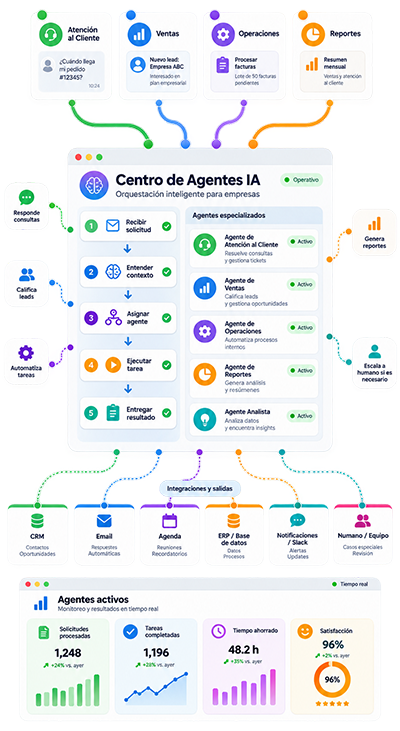
Service Overview
What exactly do I do?
I analyze processes where artificial intelligence can provide interpretation, analysis, or decision-making capabilities and develop AI agents connected to your company’s tools and data.
I can implement, among other things:
- Agents for customer service and request management
- Automatic information classification
- Document processing and analysis
- Agents for sales and lead management
- Internal assistants for teams
- Knowledge base consultation
- Information extraction and structuring
- Report and summary generation
- Analysis of emails, forms, or messages
- CRM queries and updates
- Agents connected to databases
- Action execution through APIs
- Process coordination with n8n
- Agents that use multiple tools
- Human escalation when necessary
The goal is not to use artificial intelligence simply because it is available.
It is to identify which tasks truly benefit from interpreting information, using context, and deciding what action should be taken.
Why use artificial intelligence agents?
An AI agent can do more than receive a question and return an answer.
It can analyze context, determine what it needs, use available tools, and participate within a business process.
The agents I implement can be:
- Customized, according to your business needs
- Connected, with APIs, databases, and applications
- Context-aware, capable of using relevant information for each task
- Controlled, through rules, permissions, and validations
- Measurable, with action and result tracking
- Scalable, allowing new functions and tools to be added
This makes it possible to use artificial intelligence as an active part of a process, not simply as a conversational interface.
AI Agents: Intelligence, Tools, and Actions within Real Business Processes
A well-designed artificial intelligence agent is not simply about sending instructions to an AI model.
It means defining:
what objective it must achieve, what information it can use, what tools are available, what decisions it can make, and what actions it is allowed to execute.
I can build agents that receive a request, analyze the context, retrieve information, select tools, execute actions, and evaluate the result before continuing.
Everything within an organized and controllable architecture.
What Type of AI Agents Do I Develop?
Agents for Internal Processes
- Business information retrieval
- Document analysis
- Request classification
- Summary generation
- Report preparation
- Information processing
- Internal team assistance
- Administrative task automation
Agents for Sales and Customers
- Lead capture and analysis
- Opportunity qualification
- Commercial information retrieval
- Response preparation
- CRM updates
- Process follow-up
- Conversation analysis
- Human handoff when necessary
Advanced Agents and Processes
- Use of multiple tools
- Database queries
- Knowledge bases
- APIs and webhooks
- Automation with n8n
- Document processing
- Multi-decision workflows
- Coordination between different systems
- Specialized agents by function
Benefits of Implementing Artificial Intelligence Agents
Greater Automation Capabilities
Smarter Processes
Better Use of Information
Greater Operational Control
Ready for Real Business Processes
Tools, APIs, and External Services
An agent can use different tools to retrieve information or execute actions.
I can work with:
- REST APIs
- Webhooks
- CRM systems
- Databases
- Google Workspace
- WordPress and WooCommerce
- Shopify
- Messaging platforms
- Internal systems
- Custom applications
This allows the agent to do more than simply generate a response. It can interact with the systems required to complete a task.
Action Execution
Depending on the permissions defined, an agent can perform actions such as:
- retrieve information
- create a record
- update a customer
- classify a request
- generate a document
- check availability
- send information
- create a task
- trigger an automation
- request human approval
The system analyzes the situation and uses the appropriate tools according to the established rules.
Multi-Step Processes
An agent can also participate in processes that require several consecutive actions.
For example:
- Receive a request
- Analyze what the user needs
- Retrieve information
- Identify missing data
- Use a tool
- Evaluate the result
- Execute the next action
- Record what happened
This makes it possible to solve processes that are more complex than a traditional linear automation.
Data, Context, and Knowledge Bases
An agent needs reliable information to work correctly.
I can create solutions that use:
- Business documentation
- Frequently asked questions
- Internal procedures
- Product information
- Service information
- Policies
- Databases
- CRM systems
- Data from APIs
- Relevant process history
Depending on the project, the agent can retrieve this information when needed instead of relying only on the general knowledge of the artificial intelligence model.
This allows it to generate results that are more contextualized and aligned with the company’s actual information.
Artificial Intelligence Connected to Tools
The main difference between using an isolated AI model and developing an agent lies in its ability to interact with other systems.
Some examples include:
- Retrieving data before responding
- Choosing between different tools
- Performing an internal search
- Analyzing an API response
- Updating information
- Processing a document
- Creating a task
- Executing an automation
- Requesting additional information
- Determining when a person should intervene
Artificial intelligence is used as an interpretation and decision-making layer within the process, while important actions remain controlled through rules, tools, and permissions.
The goal is to combine AI, data, automation, and business logic in a safe and useful way.
Agents Designed for Production
A business agent must operate in a controlled way even when it receives incomplete information or encounters an unexpected situation.
That is why I can incorporate:
Error Handling
Specific routes when a tool fails, an API does not respond, or there is not enough information to continue.
Limits and Permissions
Definition of what information the agent can access and which actions it is allowed to execute.
Action Validation
Checks before performing important operations or modifying business information.
Activity Logging
Information that makes it possible to review what decision the agent made, which tool it used, and what result it obtained.
Human Escalation
When the system cannot resolve a situation safely or appropriately, it can request human intervention.
Stable and Controlled Technical Development
Organized Architecture
I design agents by separating artificial intelligence, tools, data, and critical logic to avoid systems that become unnecessarily difficult to maintain.
Measurable Processes
Actions, results, and errors can be recorded to simplify analysis and monitoring of the agent’s behavior.
Architecture Ready to Grow
A well-designed agent should allow new tools, knowledge, or capabilities to be added without rebuilding the entire solution.

Why Work With Me?
I do not start with the artificial intelligence model.
I start with the process you need to improve.
Before developing an agent, I analyze what task it needs to perform, what information it requires, what decisions it can make, which systems it must query, and which actions are actually worth automating.
From there, I design the simplest and most controlled solution capable of solving the problem.
My approach combines artificial intelligence, automation, APIs, databases, tools, and business logic.
Our Process
Analysis of the Current Process
I review the task you want to solve with artificial intelligence, the systems involved, and how the process currently works.
I identify:
- what starts the process
- what information the agent needs
- what decisions it must make
- what tools it can use
- what actions it can execute
- when a person should intervene
The result is a clear definition of what the agent actually needs to do.
Agent Design
I define the architecture of the solution:
Objective, context, tools, data, rules, permissions, validations, expected result.
The goal is to build an agent that is logical, controllable, and easy to maintain.
Development and Integration
I build the agent and configure the necessary connections with artificial intelligence models, APIs, applications, databases, and automations.
I implement the tools and rules required for it to execute the defined tasks.
Testing and Validation
I test different scenarios before moving the agent into production.
I verify:
interpretation, decisions, tool usage, data, permissions, errors, human escalation, results, behavior in unexpected situations.
The goal is to avoid agents that only work when they receive exactly the expected information.
Implementation, Documentation, and Support
Once the agent has been validated, it is deployed into production.
Depending on the project, I can include:
- basic documentation
- explanation of how it works
- execution reviews
- subsequent adjustments
- maintenance
- monitoring
- implementation of new capabilities
Ongoing Support and Maintenance
Agents depend on artificial intelligence models, APIs, tools, and information sources that can change over time.
That is why I can also provide maintenance for existing solutions.
This can include:
- Execution reviews
- Error correction
- Integration updates
- Instruction and rule adjustments
- Tool usage optimization
- Permission reviews
- Improved error handling
- Addition of new capabilities
- Log analysis
- Performance adjustments
The goal is to ensure the agent continues operating reliably and remains aligned with the needs of the business.
Metrics That Can Be Monitored
Depending on the agent, it is possible to measure aspects such as:
- Number of executions
- Tasks completed
- Requests processed
- Actions executed
- Tool usage
- Errors
- Human escalations
- Processing time
- Records processed
- Leads managed
- Documents analyzed
- Results from external actions
This makes it possible to detect problems and understand what the agent is actually doing.
Results You Can Expect
- Fewer repetitive tasks
- Greater processing capacity
- Information analyzed automatically
- Faster processes
- Better use of internal data
- Less manual intervention
- Context-assisted decisions
- Systems working together
- Greater traceability
- Human intervention when it is actually needed
What You Receive With My Service
✓ Process analysis
✓ Agent architecture design
✓ AI agent development
✓ Integration with artificial intelligence models
✓ Integration with your systems
✓ API and tool configuration when required
✓ Knowledge bases when appropriate
✓ Rules, permissions, and validations
✓ Error handling
✓ Human escalation when necessary
✓ Testing before production
✓ Implementation
✓ Basic documentation
✓ Ongoing support according to the contracted scope
Common Problems I Can Solve
- Teams spending time analyzing repetitive information
- Requests that must be classified manually
- Information distributed across different systems
- Documents that require constant review
- Leads that require analysis before being handled
- Processes that require consulting multiple sources
- Teams repeatedly preparing the same reports
- Business data that is difficult to access
- Tasks that combine analysis and action execution
- Processes that require multiple decisions
- Isolated AI systems that cannot execute actions
- Existing solutions that are difficult to control or maintain
Start Your Artificial Intelligence Agent Project
Do you have a process that requires analyzing information before deciding what to do?
Tell me how it currently works.
We will review which tasks an agent can handle, what information it needs, which tools it should use, and which actions should remain under human control.
You do not need to know which AI model, architecture, or tools to use.
You only need to explain what a person currently does, what information they analyze, and what result you need to obtain.
📞 WhatsApp: +57 318 648-4818
Artificial Intelligence Agents for Companies and Businesses
I help companies and professionals implement artificial intelligence agents capable of analyzing information, retrieving data, using tools, and executing actions within business processes.
From specialized internal assistants to agents connected with CRM systems, APIs, databases, documents, automations, and proprietary systems.
If you are looking for an AI agent specialist to develop, integrate, or improve a business solution, I can help you turn tasks that require interpretation and decision-making into intelligent, controlled, and scalable processes.
Frequently Asked Questions
1. What is an artificial intelligence agent?
An artificial intelligence agent is a system that uses AI to interpret information, evaluate a situation, and determine what actions it should take to achieve an objective.
In addition to generating responses, it can use tools, query systems, and execute processes according to defined rules and permissions.
2. What is the difference between an AI agent and a chatbot?
A chatbot is primarily designed to maintain conversations.
An AI agent can participate in a conversation, but it can also retrieve information, use tools, execute actions, and coordinate different steps to complete a task.
The difference depends on the architecture and the capabilities assigned to the system.
3. What tasks can an AI agent perform?
It can classify information, analyze documents, query databases, manage leads, generate summaries, use APIs, update systems, prepare reports, execute automations, and assist with internal processes.
Its capabilities depend on the tools, data, and permissions available.
4. Can an agent connect to my systems?
Yes.
If your platforms provide APIs, databases, webhooks, or other compatible integration methods, the agent can use those connections to retrieve or update information.
5. Can it use information from my own company?
Yes.
The agent can work with knowledge bases, documentation, data from internal systems, and other authorized sources.
This allows it to use business-specific information within its tasks.
6. Can an agent use multiple tools?
Yes.
Depending on the architecture, it can have access to different tools and select which one to use according to the task it needs to perform.
For example, it can query a database, use an API, and then execute an automation.
7. Can AI agents be integrated with n8n?
Yes.
n8n can be used to coordinate processes, connect systems, and execute automations related to the agent’s decisions or actions.
8. Can an agent work with a CRM?
Yes.
It can retrieve, create, or update information within a CRM when a compatible integration is available and the appropriate permissions have been defined.
9. Do AI agents operate completely autonomously?
Not necessarily.
The level of autonomy should be defined according to the process and the risk associated with the actions.
An agent can execute some tasks automatically while requiring human approval for other important operations.
10. How do you prevent an agent from executing incorrect actions?
The architecture can incorporate permissions, validations, rules, limits, logs, and human approvals before certain actions are executed.
Critical operations should not depend solely on a decision generated by the artificial intelligence model.
11. Can you review an existing AI agent?
Yes.
I can analyze existing solutions to identify issues related to architecture, instructions, tool usage, context, error handling, permissions, or opportunities for optimization.
12. How much does it cost to develop an artificial intelligence agent?
The cost depends on the number of processes, tools, integrations, information sources, rules, AI models, and complexity of the tasks involved.
A simple assistant requires much less development than an agent connected to multiple systems and capable of executing business processes.
For that reason, each project is evaluated according to its actual scope.
13. How long does it take to develop an AI agent?
It depends on the complexity.
A simple agent can be developed in a few days, while solutions involving multiple tools, integrations, permissions, testing, and processes may require several weeks.
Before starting, the scope and estimated timeline are defined.
14. Do I need technical knowledge to use an AI agent?
No.
The agent can operate in the background or integrate with the tools your team already uses.
The goal is to keep the technical complexity behind the process.
15. How do I know if my business needs an artificial intelligence agent?
There is probably an opportunity if you currently:
- have a person analyze information before repeatedly performing similar actions
- classify large numbers of requests
- consult several platforms to complete a task
- repeatedly process documents
- prepare reports using different sources
- manage leads that require prior analysis
- have business information that is difficult to retrieve
- use AI in isolation but still need to perform the subsequent actions manually
In these situations, it is worth analyzing whether an agent can participate in the process in a controlled way.